

With the effective promotion of cloud migration and cloud construction in major industries, the continuous growth of the scale of business systems, and the growing demand for IT infrastructure, private clouds and public clouds of various types and cloud vendors have been generally built in industries such as finance, party and government, and large central state-owned enterprises, as well as various types of virtualized IT infrastructure resources. With the development of software architecture, there are also various applications such as traditional three-layer architecture, SOA service architecture, and microservice architecture, and the unified and intensive management of IT assets in information systems and data centers is becoming increasingly prominent.
Through the multi-cloud management platform, the rapid deployment of IT environment and automatic software deployment can be realized, and the resource allocation of each virtual machine can be flexibly adjusted, the service life of virtual machines can be managed, and the level of automation can be improved. Achieve automated, unified management, resource sharing and automatic configuration, so that applications can focus more on their own business, which is conducive to innovation and cost reduction
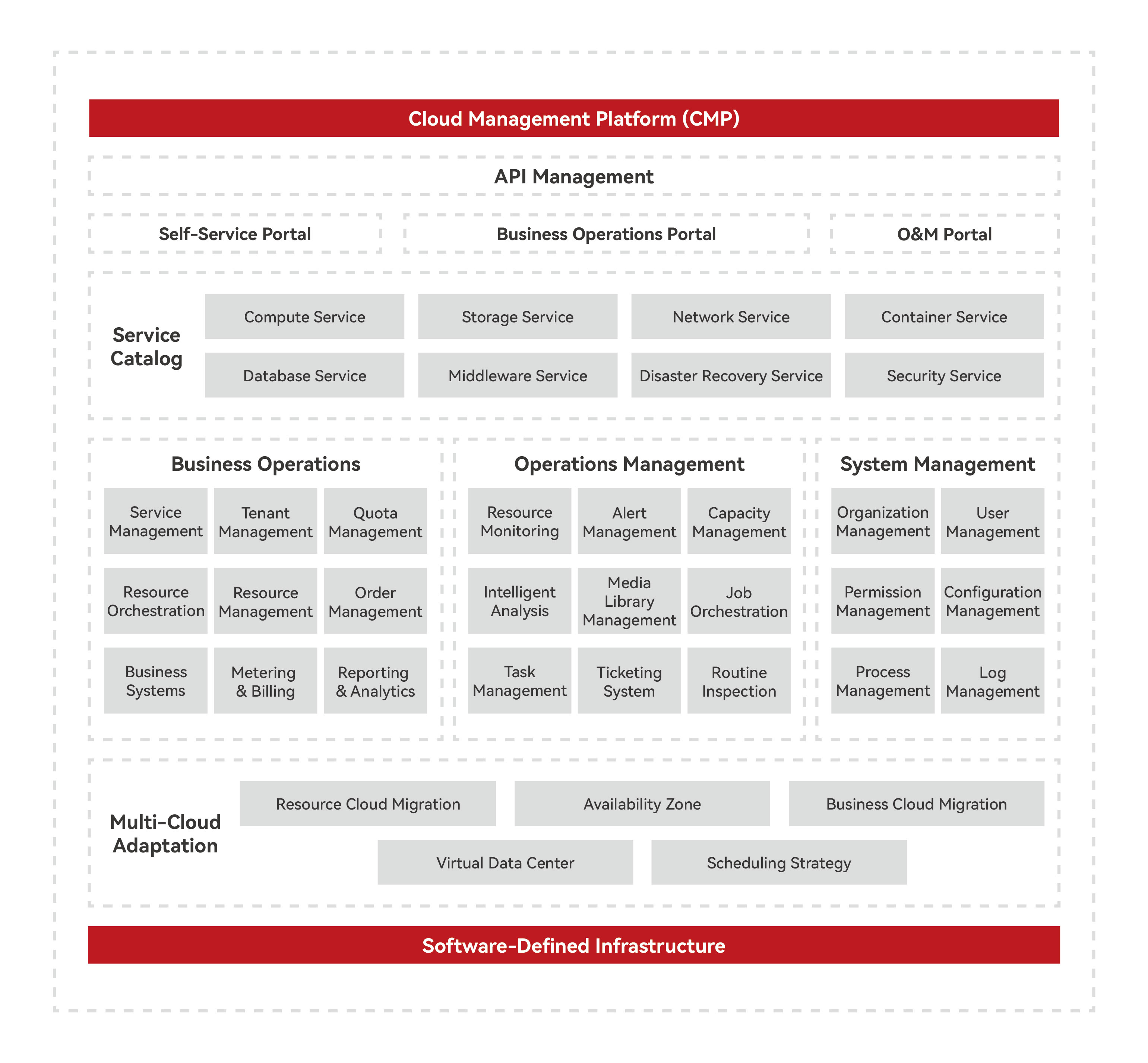
The O&M part of the fully converged multi-cloud management platform includes unified collection, configuration management, unified monitoring, unified alarming, unified logging, service management, unified reporting, visual O&M, and O&M center.
The operation part mainly realizes service catalog management, service operation process, service quality management, operation tenant management, service operation center, unified user system, etc.
The cloud service segment provides a variety of cloud-based services, such as elastic computing services, automatic deployment, virtual machine high availability, network management and security, etc., and cloud users can choose suitable cloud services according to their needs to build the basic environment for IT project operation.
Standard API interfaces are used to integrate the multi-cloud management platform with peripheral third-party systems, such as work order interfaces, message interfaces, unified identity authentication platforms, and financial investment information project management system interfaces.
Solution Advantages

7*24-hour Service Hotline
400-6300-003